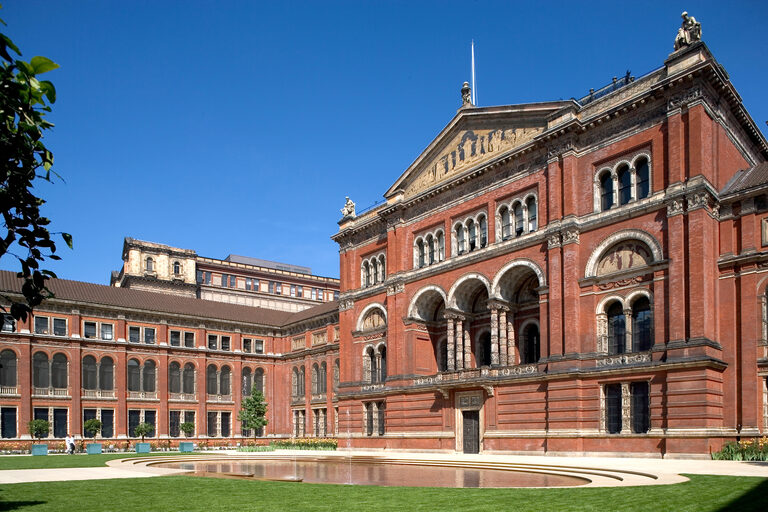
The John Madejski Garden, the courtyard in the middle of the museum, with its oval paddling pool.
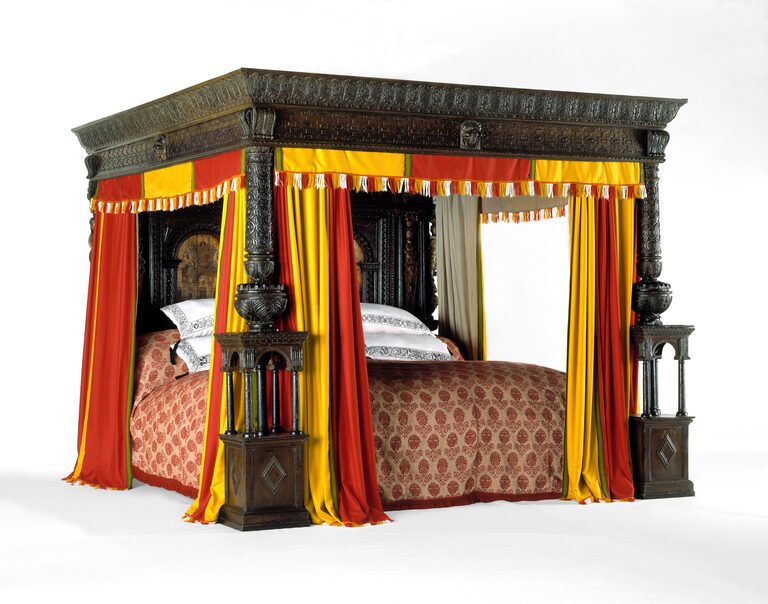
The Great Bed of Ware, made around 1590 and over three metres wide, in the British Galleries (Room 57).
OK, now the Victoria & Albert Museum (known colloquially as the ‘V and A’) is a really strange museum. It’s nominally centred around the themes of art and design (‘decorative and applied arts’), but what you actually get is a labyrinth of hard-to-navigate rooms and staircases containing a bunch of objects that don’t really fit in any of the other museums.
So the ‘galleries’ (sets of rooms) are all completely different from one another. There’s not even any agreement between them on the way they should be classified - some of them are particular materials (e.g. ‘Ceramics’), some are locations (e.g. ‘China’), some are disciplines (‘Theatre and Performance’) and some of them are chronological eras (e.g. ‘Design 1900 – Now’). If the museum ever acquires any Chinese 20th-century ceramic theatre props then the whole building will instantly disappear in a haze of logic.
Some of the galleries are quite good, some of them are Stupefyingly Boring. The overall impression is one of pervading chintz - perhaps this is intentional, as the museum’s original contents came from the Victorian Great Exhibition.
On the upside, it’s free. On the downside, it’s large chunks of it are rather dull for kids, unless maybe they’re very into art and design.
Good bits
- The Theatre gallery: this used to be a little standalone museum of theatre in Covent Garden, which was transplanted into the V&A in 2009. It’s pretty good, if your kids are keen on theatre. There’s some costumes to try on and some more historically-important ones to look at, there’s some interesting props and some scenery models; it’s pretty good. When we went in 2014 there was a big rhino, and before that the horse from War Horse, which is now at Young V&A in Bethnal Green. Appealing to children. Level 2.
- Paddling pool in the middle of the main courtyard.
- When we went in 2014 there was an interactive design-your-own-teapot exhibit in the Ceramics galleries (level 6), which was pretty good fun - you could make a teapot with 12 spouts and no handle (or 12 handles). Although when we tried to email daughter1’s design to show to mum when we got home, that didn’t work. Still, worth a visit if you’re in the upper regions of the museum.
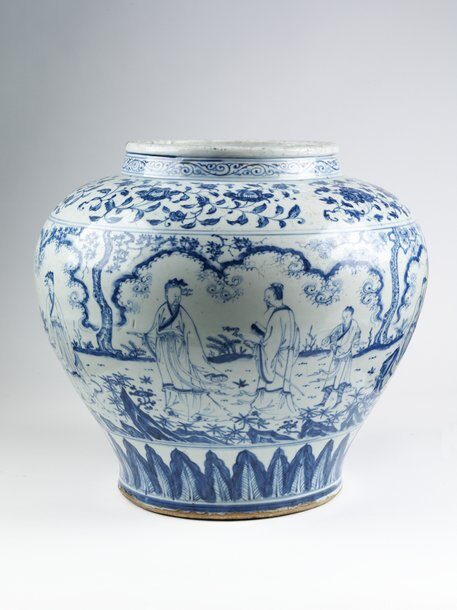
Tedious Jar, 15 century, Jingdezhen.
Navigation
Be sure to take your map and compass, and always leave a message with a friend or relative to alert the emergency services if you don’t return in a few days. No but seriously folks (I’m here all week! try the veal!), the easy way to find a particular gallery is to ask the staff on the way in. Usually they’ll be unable to describe the route (because such a description is impossible unless both you and they have degrees in advanced topology) and will just take you.
Access
Both main entrances (Cromwell Road and Exhibition Road) are step-free, and lifts (elevators) reach every level. But the building is a maze of split levels and not every lift goes to every floor, so ask staff for the best route or find the lifts on the V&A’s digital map. South Kensington station isn’t step-free; Knightsbridge is the nearest station that is.
Cool thing for adults: The National Art Library. But know in advance what you want to see, register in advance as a Reader, and leave the kids at home.
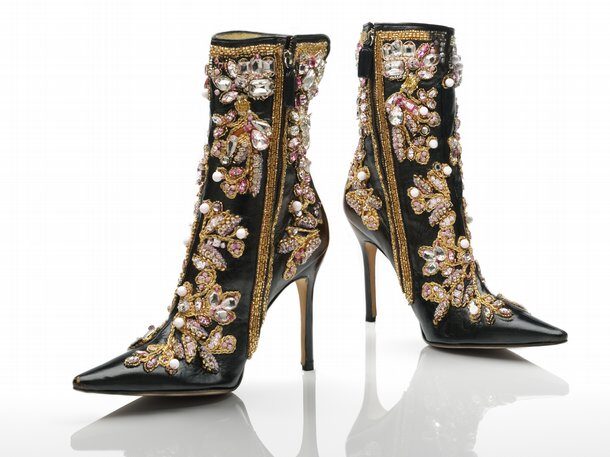
Ankle boots, black leather stiletto heels with gold, white and pink embroidery, Dolce & Gabbana.
🛜 Free WiFi throughout the museum, with no password. When you join, you’ll be asked to accept the terms and conditions.