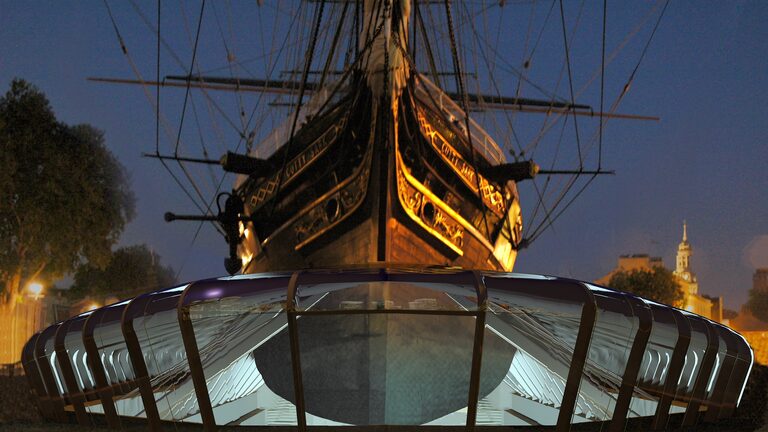
An artist’s impression of the Cutty Sark at night, with the glass canopy round her hull.
The Cutty Sark is a large sailing ship, marooned in a dry dock and converted into a museum that covers a smorgasbord of educational stuff – from the history of the ship itself, to trade routes and the process of tea-growing. It’s a charming mixture, and means that it has something for everyone. 3yo ‘Anna’ enjoyed the wooden farm animals and the drawer with a sample of sailors’ smelly socks. 6yo ‘Elsa’ learned to tell the bow from the stern, and port from starboard. Both very much liked the ‘sailor’ who ‘press-ganged’ them and taught them to sweep the decks and serve the Captain’s dinner.
Costumed characters, such as Captain Woodget or James Robson the cook, are on board at weekends in term time and on set days in the school holidays, but not on the first weekend of the month. They roam the ship from 10:30am to 12:30pm and 1:30pm to 3:30pm, with shows in the Dry Berth under the ship at 11:30am and 2:30pm, included in the ticket.
‘Elsa’ wanted me to tell you the following (I’m working on adding adjectives other than ‘cool’ to her vocabulary, but at the moment it’s more than a bit over-used):
- I think it was the best trip I’ve ever had. [Mum-type note - not sure this is strictly true.]
- It was really cool getting to go on all the three decks.
- The rudder was especially cool.
- The Cutty Sark was so big that it carried over 10000 boxes of tea on its first trip.
- My little sister liked it too.
- It was really cool.
Anyway, back to the ship itself. You work your way up through the hold, learning about growing tea and prevailing winds and trade routes on a rather nifty globe. Up another level, and you get some more displays including a wobbly bench to get the feeling of being at sea, but by this time you’re keen to get on deck. Once up and out (it’s completely open, you will need weather-appropriate clothing) you can potter around looking at ropes, bunk beds and masts. For a guided tour you need to time it right: tours leave from the gallery under the ship at 12pm and 2pm daily and cost extra (£5 for adults, £2.50 for children); ask at the front desk to join one. Free 25 to 30 minute talks also run at 10.30am and 3.30pm in different places around the ship. Dressing-up costumes (sailor, captain or witch) are on the decks below and in the Dry Berth under the ship. Then you head back down via a separate block of stairs, past the toilets (or, in our case, back to the toilets for the third time) and end up underneath the ship. The ship is suspended above the dock, so you can sit underneath it, on a bench or in the café, while looking at a collection of figureheads and displays about the ship’s restoration / disastrous fire / second go at restoration. Food and drink are only allowed in the café, though, so if you bring sandwiches, eat them outside in Cutty Sark Gardens next to the ship, or in Greenwich Park.
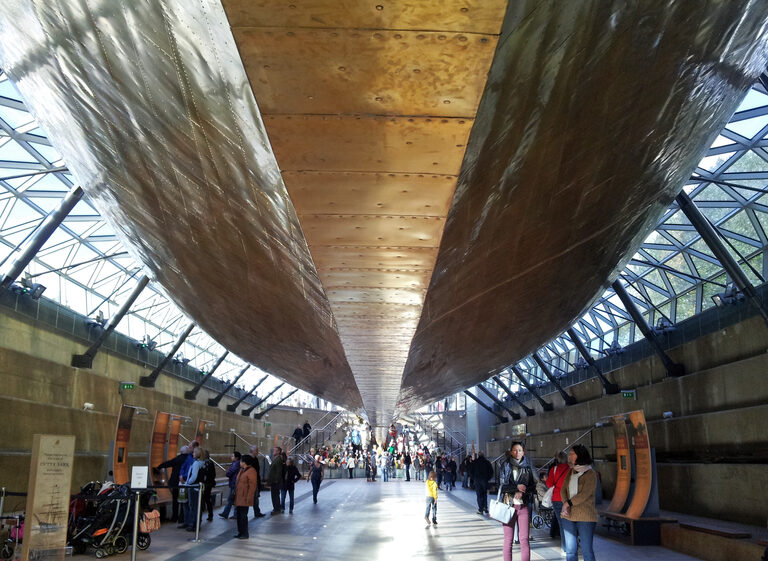
Walking underneath the ship’s hull, inside the glass canopy.
I found the whole thing a little dumbed-down – but then, it’s aimed at children and tourists for whom English isn’t a first language. On the up-side, when we went the café did excellent coffee and catered well for a variety of food allergies (though we had brought our own sandwiches, as usual). Today it offers plant-based milk free of charge, and if anyone in the family has allergies, ask the staff before you order. And the architecture of the museum is pretty amazing, they’ve glassed over the dry-dock so that the glass is at the level the water would have been, and it looks very cool.
There’s buggy parking under the ship and lifts to every main deck, though for the full experience on deck you do need to park the buggy (stroller) and carry babies to get right up to the prow, or into the Captain’s cabin. It’s also well set up for blind / partially sighted visitors – and things like touchable models of the ship’s structure work well for children, too.
It’s a big-name London attraction, so it is expensive to get in – £22 for adults and £11 for kids aged 4-15 (under-4s go free) – but there are deals you can use to make it cheaper. If you’re coming into London by train, the National Rail 2FOR1 scheme covers the Cutty Sark: you have to book online in advance and show your train tickets on the day. A National Rail ticket to ‘London Terminals’ or Greenwich counts, even the cheapest Off-Peak or Advance fare, as long as it’s valid on the day you visit, and so do Gatwick Express and Stansted Express tickets. Oyster or contactless pay-as-you-go journeys, Tube, DLR or bus-only tickets, Heathrow Express and Eurostar tickets don’t count. The Day Pass that also covers the Royal Observatory, up the hill in Greenwich Park, can’t be used from 2 November 2026, when the Observatory closes for refurbishment; its Meridian Courtyard is due to reopen in summer 2027, with tickets on sale from January 2027. Both in one day is too much for young children anyway. For older kids, particularly if the weather is decent, there’s a long but interesting walk from the Cutty Sark along the Thames (about 2 miles, so allow at least 45 minutes), past relics of London’s industrial past, to the Pointless But Fun Cable Car, which gives a great view of Docklands and the Thames Barrier. There isn’t much to do on the other side, when you get there, but it’s fine just to come straight back on the cable car again, and then hop on the tube at North Greenwich.
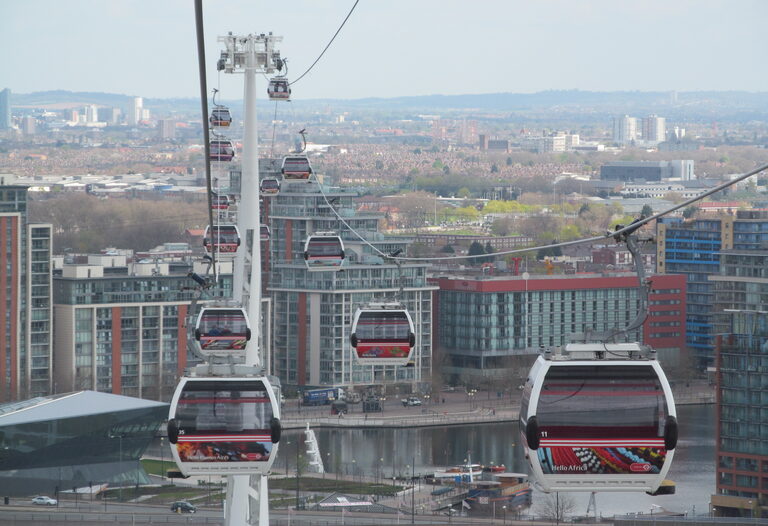
The cable car, then called the Emirates Air Line, arriving at the Royal Docks.
🛜 Free WiFi on board, which is worth joining as phone signal is weak in parts of the ship.