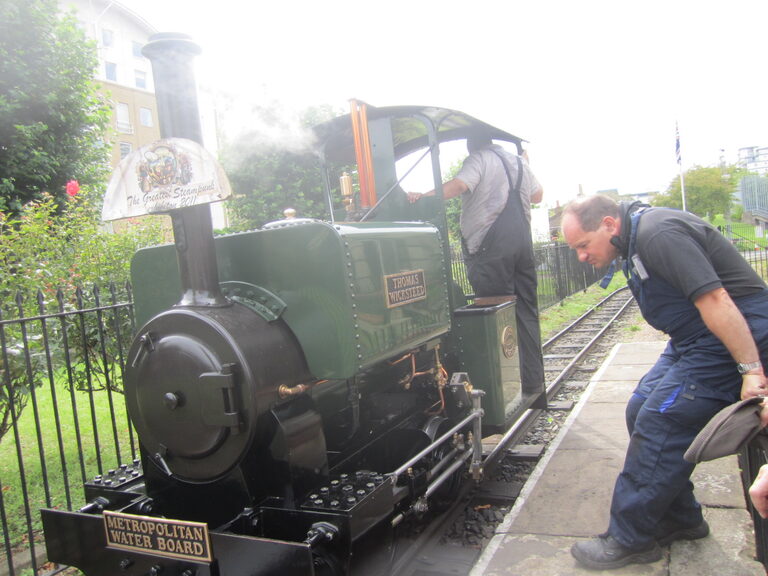
The museum’s small steam engine, with its crew getting it ready.
The London Museum of Water and Steam (revamped and renamed in 2014 - it used to be the Kew Bridge Steam Museum) is one of my very favourite places to take kids in London. It’s got everything you might want - a steam train, massive great pumping engines that actually pump, fantastically knowledgeable volunteers who are happy to explain stuff to kids, water play with an educational theme (closed for building work until about summer 2027) and a nice cafe.
My one complaint is that 3yo Anna doesn’t really want to get off the steam train (at £1 per person per ride, on top of the entrance fee, that soon adds up) and won’t eat any of the sandwiches that the cafe sells. But that’s really not the museum’s fault. You pay for train rides at the front desk, and children aged 2 and under ride free. The train usually runs only one weekend a month, and not on weekdays, so check the museum calendar before you promise anyone a ride.
The entrance is a bit unprepossessing - you turn right out of Kew Bridge station and work your way towards the big tower, crossing the car park to get in. But once you’re in, its great. The revamp means that it’s almost all buggy (stroller) accessible, and there’s a small buggy park by the shop and cafe near the entrance if you’d rather not take it round. The lovely staff at the front desk will also lend you spare clothes, nappies (diapers) and wipes if you run out.
The ramp takes you down to an interactive exhibition about clean water, sewage and a fake sewer which small people can explore and find the ‘rat’. Or you can stay on the entrance level, and go straight for the pumping engines. These are usually working on Steam Up weekends, and are truly impressive in a clanging, hissing, steaming, whizzing sort of way. The volunteers who run them are incredibly knowledgeable - last time I was there I learned that you have to make sure the beam engines with flywheels stop in the right position: if the crank stops in line with the rod (on ‘dead centre’), or with the steam valve shut, steam alone can’t start them again, and the crew has to lever the flywheel round by hand. And that the Cornish engines are definitely the hardest to run. This is the sort of obscure fact that I feel really justifies a trip to a museum. The engine house with the two biggest Cornish engines (the 90 inch and the 100 inch) is closed for renovation at the moment, though.
Beyond the pumping engines you go up a few steps - there’s a step-free route for wheelchairs (ask the staff), but I would just carry a buggy (stroller) - and, if it’s not raining, head straight out of the back door to the little steam train. The museum has a little steam engine, Thomas Wicksteed, and a diesel, Alister. When we went, the diesel pulled us to one end of the yard, then the steam engine came along, got coupled on, and pulled us back to the tiny platform.
Small fans of Thomas the Tank Engine and his ilk will be delighted. I very much enjoyed the sit-down, and the fact that last time we went the usual middle-aged male engineer was joined by a teenage girl who was running the steam engine and (incidentally) providing a fantastic role model of being interested in engineering and getting your hands dirty for my two daughters.
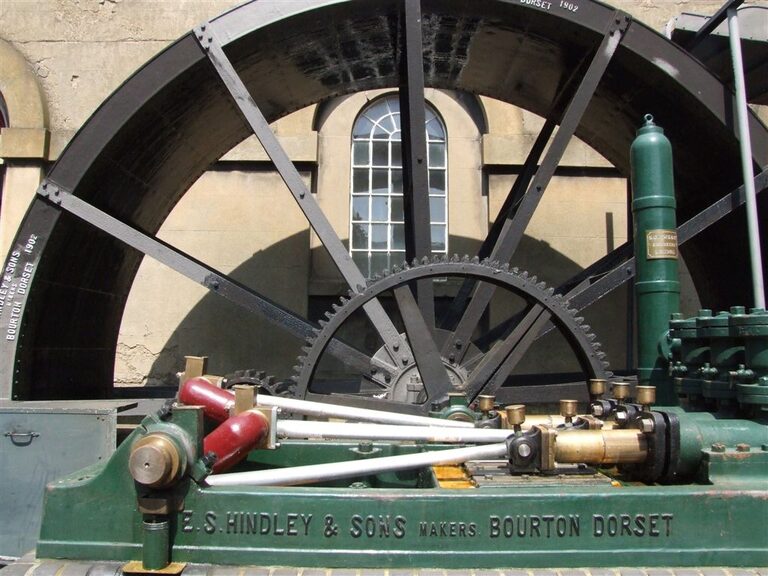 A three-cylinder water pump made by E. S. Hindley & Sons, with the 1902 water wheel that drives it behind.
When you’ve enticed your small people off the train, there’s a small but excellent water play area, the Splash Zone. It’s closed for building work from 26 October 2026 and is expected to reopen in summer 2027. Even in a normal year it shuts for the winter and may close in bad weather, so check before you go. One section allows you to work out how to dam a lake to make water wheels spin, another allows you to build an aqueduct to make a water wheel spin and the other is about building a dam to… wait for it… make a water wheel spin.
This is all at a useful height for toddlers but seems to engage children up to, well, about 67 based on the grandad I met last time I was there. The other part of the Splash Zone is more suitable for older children, as 3yo Anna couldn’t manage the Archimedes Screw and the pump on her own. But its still interesting and educational and not too splashy as long as you roll their sleeves well up. And quite fun for me, too.
After that, there are some more pumping engines (one has goldfish in its pool) and a huge water wheel (handily next to the water play ones, for comparison). The cafe (now called Bella Puglia) is by the shop near the entrance, and you can use it without a museum ticket. There’s also a pleasant little garden tucked away down the side, which is ideal for picnics. There aren’t that many gardens with a giant iron beam from an old pumping engine in them, which adds to the charm.
It’s quite an expensive entrance fee for adults (£12.00) but children are much cheaper (£4.00 for ages 5-16, under 5s go free) and the family tickets are good value (£13.00 for one adult and two children, or £25.00 for two adults and two children). The museum is open Thursday to Sunday, 10am to 4pm, in term time, and daily during the school holidays. It’s definitely worth checking the museum calendar, as it’s much more fun if the engines are in steam - this happens on monthly ‘Steam Up’ weekends (usually the last full weekend of the month), plus a New Year’s Steam Up at the end of December. I’ve never seen it crowded, so no need to avoid weekends or school holidays.
The museum isn’t in central London so you need to get a train from London Waterloo to Kew Bridge station - it takes about 25 minutes and there are two trains per hour from Monday to Saturday (on Sundays it’s one per hour until about 2pm, then two per hour). Engineering works often change this at weekends, so check the National Rail journey planner for train times. It’s one of those annoying stations with a rather large gap between train and platform and also no lift (elevator), and, outside match days, not that many other passengers, so you might have to carry a buggy (stroller) up by yourself. It gets very busy before and after Brentford FC home matches at the stadium next to the station, so check Brentford’s fixtures before a weekend visit. I usually put Anna on my back in a sling, as that makes it much easier and safer, in terms of having a hand free to hold on to 6yo Elsa when getting off the train.
A morning with the steam engines could easily be followed by an afternoon at Kew Gardens (it’s about a 15 minute walk over the bridge). And then you could, if the weather is nice and the small people will cope with 1 1/2 hours on the river, pick up a boat from Kew back to Westminster.