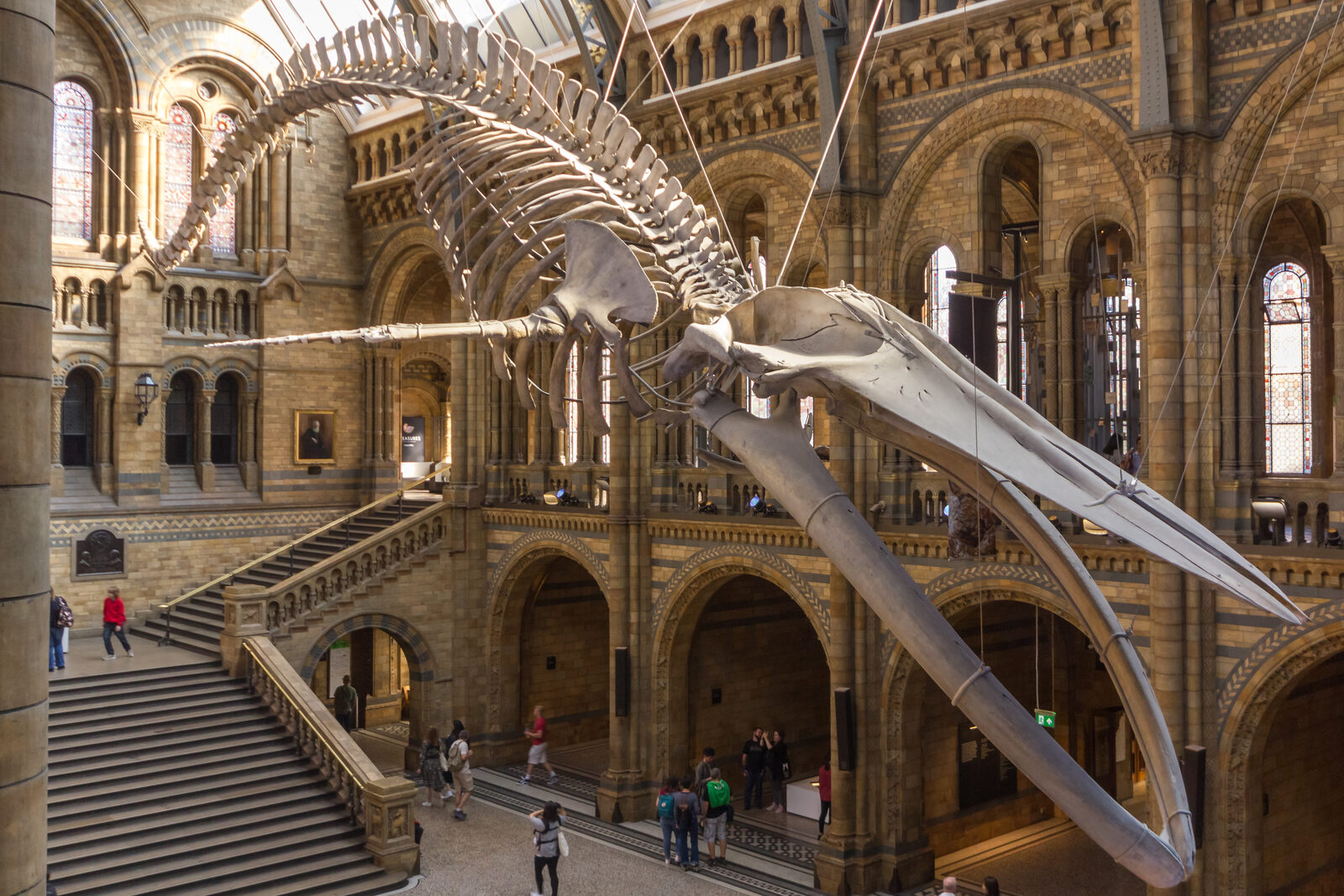
Hope, the blue whale skeleton, in the main hall.
Pros:
- Loved by small children, particularly the dinosaur section.
- It’s free (but you should make a donation or buy something, really). Special exhibitions cost extra but are usually well worth the money.
- The NHM is massive - lots to see. Don’t forget the free gardens outside, with wildlife ponds and Fern, a full-size bronze Diplodocus.
- There’s a big clean ‘picnic room’ in the basement (Lower Ground Floor) where you can eat your own food, with toilets and baby changing right next to it. On weekdays in school term time it’s kept for school groups from 11am to 2pm, but you can picnic in the museum’s gardens instead.
Cons:
- Big queue to get in at busy times. (Try the side entrance).
- Dinosaur section gets super-busy, particularly in the summer season, and you have to queue again - sometimes for quite a long time - to get into it. Ways to avoid the queues:
- Get there at museum opening time.
- Get a free timed entry ticket in advance.
- Become a member in advance.
- It’s pretty similar to other big national-grade nature museums such as the Smithsonian. So if you’re visiting from outside the UK and you’ve already been to your own country’s version of this museum, then maybe give it a miss.
Best bits:
- Dinosaurs!
- Sleepovers in the museum are said to be really good (for older children), although we haven’t done it as a family ourselves.
- Big. Blue. Whale. (Mammals Hall)
Boring bits:
- Geology and the Earth galleries in general. Except for the moving-floor earthquake room (Volcanoes and Earthquakes gallery, second floor, East Wing), which needs no ticket.
OK, so every small child seems to love dinosaurs. Daughter1 did when she was little, and now daughter2 does as well. The uncontested highlight of the dinosaur section is the roaring animatronic T-Rex (see photo below).
The problem with the dinosaur section is its popularity. To avoid the so-long-it’s-frightening Dinosaur Queue, get to the museum as it opens in the morning (or even queue up outside a bit early) and go to the dinosaur gallery first. On busy days, especially at weekends and in school holidays, the queue can stretch back down the corridor and out into the main hall.
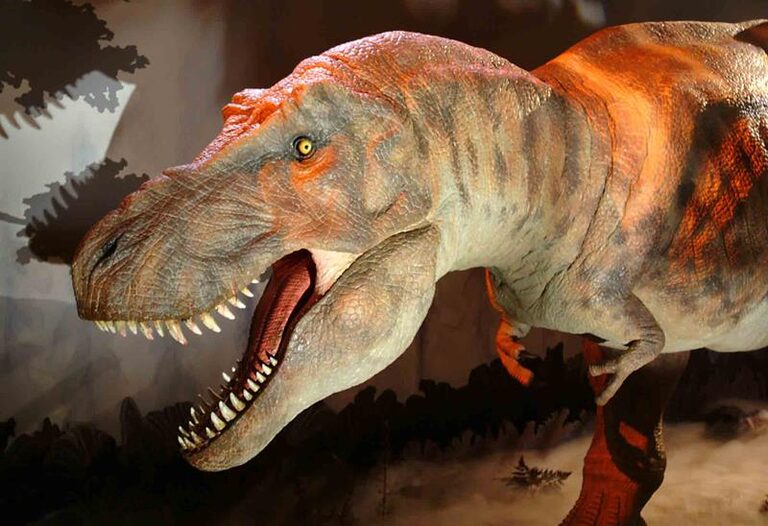
The animatronic T-Rex (“Mrs T-Rex” to our family).
Mammals Hall including “The Big Blue Whale”
Worth going to this (it’s free) because every child loves the Big Blue Whale (as daughter2 has got older, we’ve now firmly established in her mind that it’s not the Big Bad Whale). Also there’s a bunch of other exotic-but-familiar animals (giraffe, hippo, elephant) as well as some more obscure ones which you can challenge older children to remember the names of. Up on the top level there were some dolphin-related computer games when we last went - ancient, but our kids still found them fun - and you can go round to the nose of the Big Blue Whale and stand and contemplate it. Also with smaller children view from the upper gallery is a good way to play ‘spot the animal’.
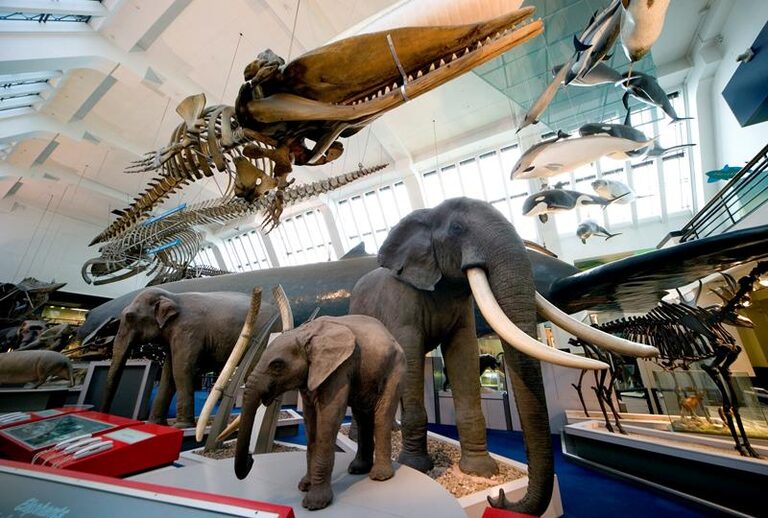
Mammal gallery, including the Big Blue Whale.
This is Dippy, the diplodocus skeleton cast who for decades was the museum’s much-loved main hall dinosaur. Note for little kids: Dippy is not dead, he’s just gone on holiday.
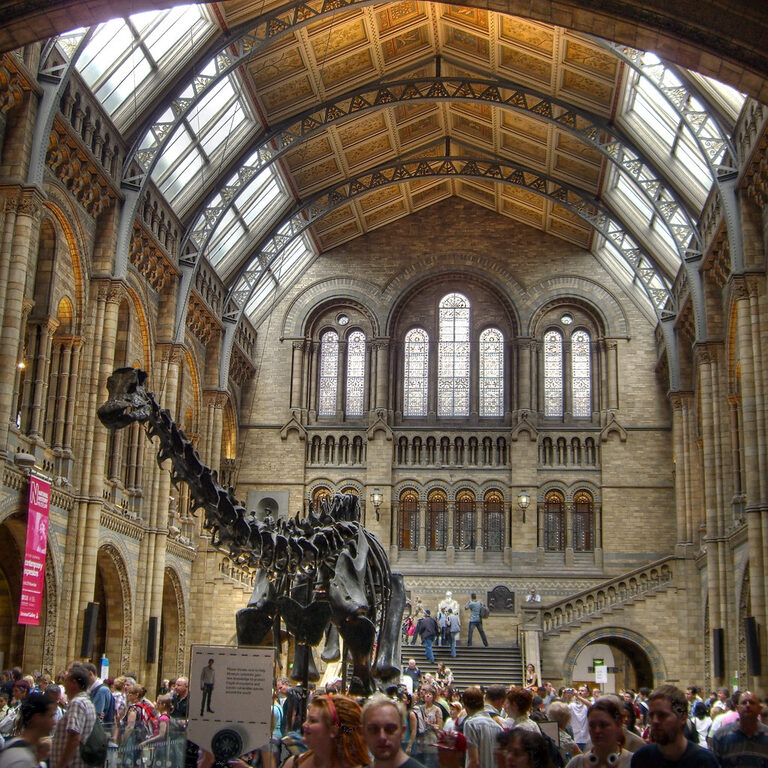
Dippy the diplodocus in the main hall, where the blue whale hangs now.
🛜 Free WiFi throughout the museum. Connect to ‘NHM-Free-wifi’ and accept the terms and conditions. You may be asked for an email address, but you don’t have to give one.