| Into central London | |
|---|---|
| Train time (mins) | 20–25 |
| London terminus for train | London Bridge or Bank |
| Train cost per adult (£) | 3–4 |
| Driving time (mins) | 35–55 |
| Taxi cost per vehicle (£) | 47–65 |
| Ride share cost per vehicle (£) | 37–150 |
| Coach cost per adult (£) | No coach |
We checked these figures in October 2026. The Travel page explains how we measured them.
For families
- London City Airport’s page on travelling with children: there’s baby changing after security, and most cafés have highchairs and hot water for bottles; there’s no play area or feeding room, but you can ask staff to let you breastfeed privately in the First Aid room, in the main terminal before security.
- London City Airport’s security page: liquids can stay in your bag but must be 100ml or less, apart from baby milk and food for the journey, and car seats must go in the hold.
- Passport control: children aged 8 or over who are at least 120cm tall can use the eGates with an adult, and other children queue with you for a Border Force officer.
For autistic travellers
- British Airways’ visual guide for autistic travellers: simple pictures and words describe each stage of a flight with BA, the main airline at London City, from arriving at the airport to collecting your bags.
- London City Airport’s visual guide (PDF, 2017): photos and short notes on each step from the DLR (Docklands Light Railway) to the plane and back through passport control; some details are out of date, because liquids and laptops now stay in your bag at security.
- AccessAble’s photo guides to London City Airport: step-by-step photos of each part of the airport, made for disabled travellers with the airport’s help.
- Unofficial videos filmed in 2025 and 2026 follow the walk between the DLR and the plane when leaving and arriving.
- London City Airport’s special assistance page: email customerfeedback@londoncityairport.com before you travel and a member of staff will walk you to your gate; the page also lists a quieter seating area and how to get a Sunflower lanyard, which tells staff you may need extra help or time.
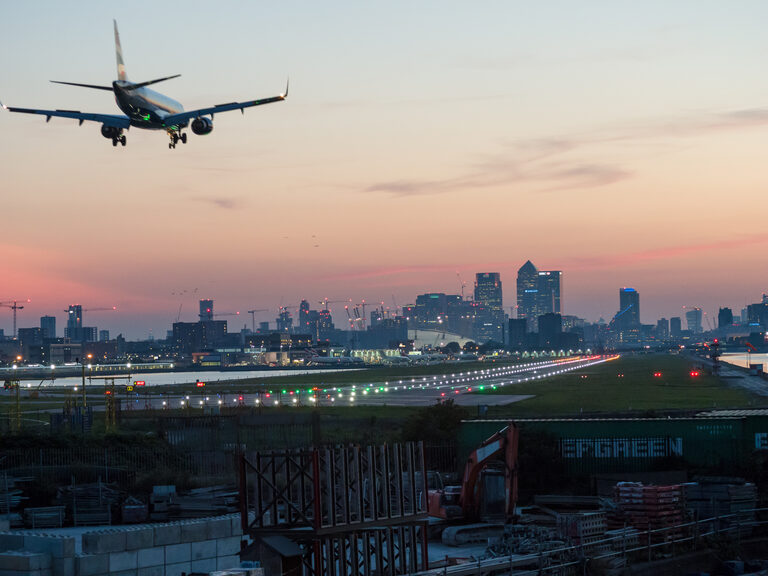
A plane coming in to land at London City Airport at sunset, with Canary Wharf behind.
London City Airport is in the Royal Docks in east London, about 9 miles east of Charing Cross by road, and it’s the closest airport to the centre. It’s small, and the airport reckons on about 15 minutes from plane to train. The DLR station is next to the terminal, with a lift (elevator) from the platforms, so the station is easy to use with a buggy (stroller) or lots of luggage.
Getting into London
We checked these fares in October 2026.
By Docklands Light Railway
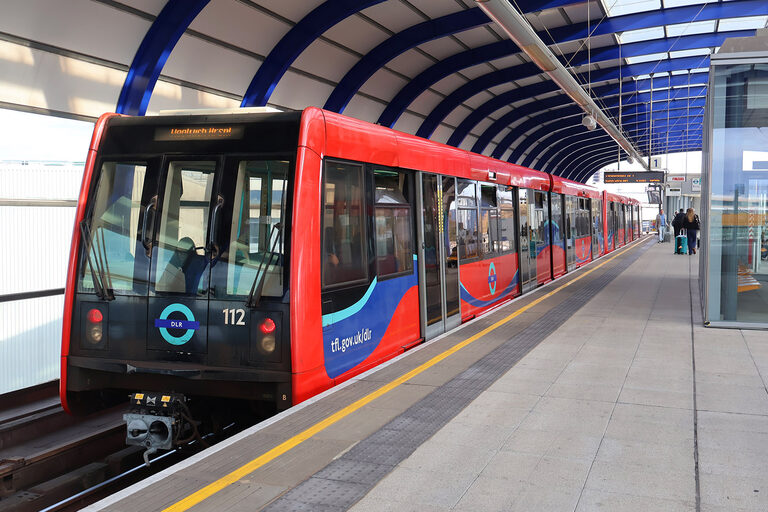
A DLR train at London City Airport station. Most DLR trains are red and blue, though a few new white and turquoise ones have started running.
The DLR is the quickest and simplest way in. Trains run every 4 to 10 minutes, straight to Bank in the City (about 23 minutes) or to Stratford. A trip to central London costs £3.30, or £3.90 on weekday mornings from 6.30am to 9.30am.
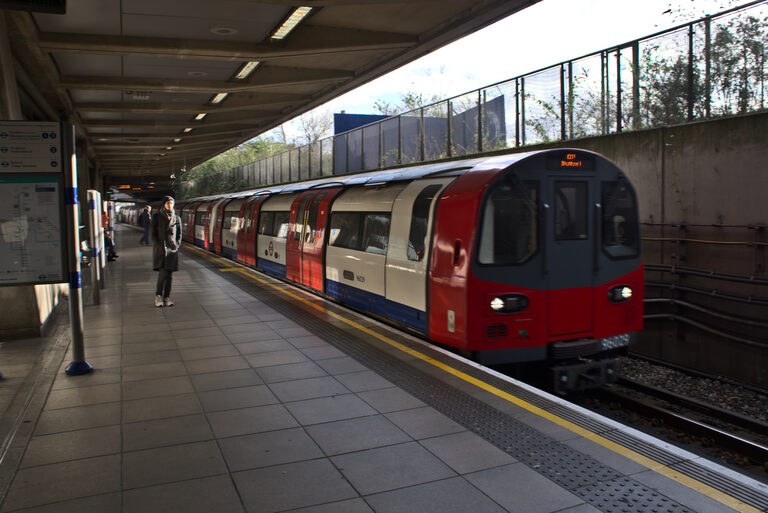
A Jubilee line train at Canning Town, where you change from the DLR for Waterloo, Westminster and the West End.
For Waterloo, Westminster or the West End, take the DLR to Canning Town (about 6 minutes) and change to the Jubilee line; the journey to Waterloo takes about 22 minutes in all, for the same fare. For the Elizabeth line, take the DLR to Stratford (about 15 minutes) and change for Liverpool Street, Tottenham Court Road and Paddington; the journey to Tottenham Court Road takes about 35 minutes in all, again for the same fare.
Buying tickets for the DLR
Paying by contactless
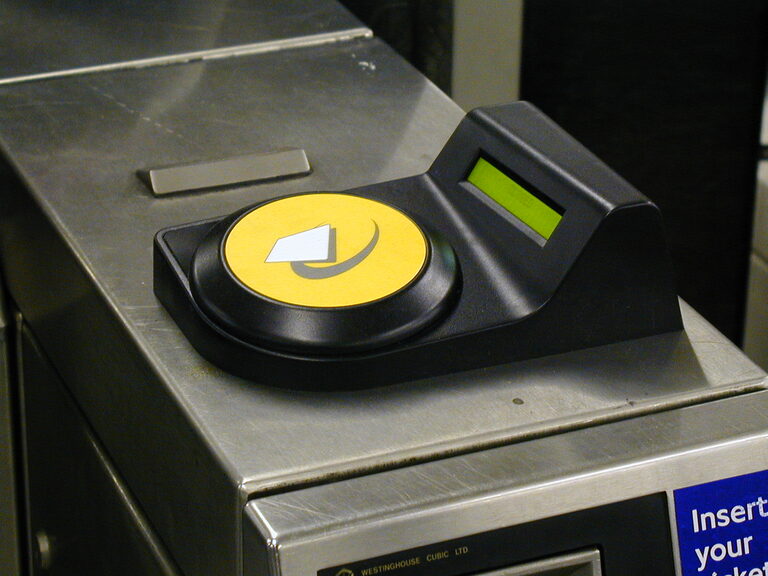
A yellow card reader on a London Underground ticket gate. Adults touch in on one at the start of the journey and touch out at the end.
- Adults can pay for the DLR by touching a contactless bank card, or a phone or watch with Apple Pay or Google Pay, on the yellow reader as they go into the airport’s DLR station and again at the end of the journey.
- Each person travelling on contactless needs a separate card or phone, but a phone or watch counts as a different card from the bank card linked to it, even on the same account, so one parent can pay for two people, one touching in with the card and the other with the phone.
- Use the same card/phone every time, and keep your phone charged, or you risk overpaying.
- Hold only one card or phone to the reader, and keep other cards away from it, or the reader may charge the wrong one.
- Many cards from abroad work, but your bank may charge an overseas transaction fee, and a phone linked to a non-UK card sometimes doesn’t work, so carry the card itself as well.
- Contactless only charges adult fares, so see Children’s tickets below for what children pay.
- If you use the same card or phone all day, Transport for London’s (TfL’s) daily cap stops your fares at £10.50 for Zones 1 to 3 (London City is in Zone 3).
Children’s tickets
- Up to four children under 11 travel free with each paying adult on the DLR, Tube and Elizabeth line, and they don’t need a ticket or card.
- Children aged 11 to 15 pay the adult fare by contactless (£3.30), or half fare with TfL’s Young Visitor discount on an Oyster card (£1.65 to central London off-peak), which lasts up to 14 days.
- Staff at any Tube or London Overground station, at some Elizabeth line stations and at TfL’s Visitor Centres can add the Young Visitor discount to an Oyster card or a Visitor Oyster card while the child is with you, for example at Canning Town, the first Tube station on the way into town.
- An Oyster card costs £10.50, which TfL doesn’t refund, so for a single trip into town an 11 to 15-year-old pays less on the adult fare, but over a few days the discount saves more than the card costs, because it also halves their daily cap to £5.25.
- Young people aged 16 and 17 pay the adult fare unless you applied before your trip for a 16+ Zip Oyster photocard (£22), which halves their fares, or they already have a 16-25 Railcard on an Oyster card, which takes a third off off-peak fares.
Paying at the airport
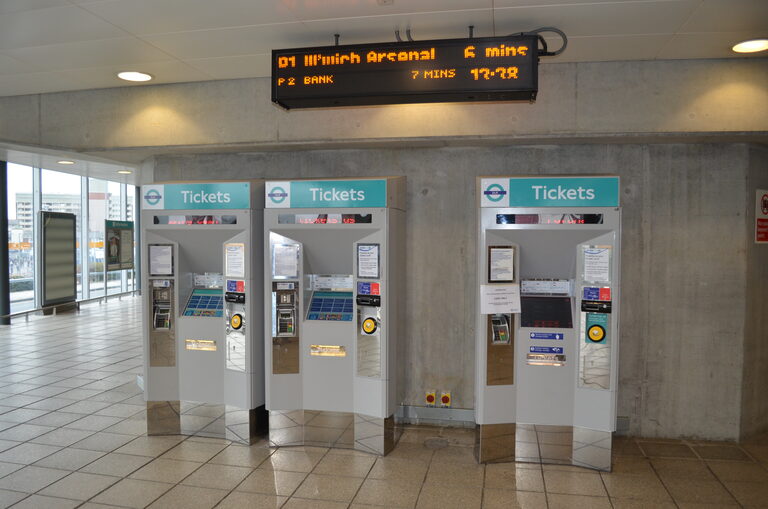
DLR ticket machines at London City Airport station.
- Adults pay £3.30 to central London on the DLR by contactless or Oyster, or £3.90 if they touch in between 6.30am and 9.30am on a weekday.
- The DLR station is joined to the terminal, so you can walk straight there after collecting your bags, and it has ticket machines and a staffed ticket office.
- The machines sell paper single (one way) tickets and Day Travelcards and top up Oyster cards, and they take cash as well as bank cards.
- The ticket office is open from 7am to 9pm on weekdays, 7am to noon on Saturdays and 11am to 9pm on Sundays.
- Staff at the ticket office sell Oyster cards (£10.50 each, which TfL doesn’t refund).
- TfL doesn’t sell Visitor Oyster cards at the airport or anywhere else in London, but an ordinary Oyster card works the same way for travel.
- The DLR ticket machines’ start screen has flags for switching from English to Français, Deutsch, Español, Polski, Italiano, Svenska or Nederlands.
Booking ahead online or in an app
- You don’t need to book the DLR ahead, or use Trainline or any other booking app, because contactless or Oyster covers the whole trip into town, and TfL doesn’t sell DLR single tickets in advance.
- TfL’s Visitor Shop can post Visitor Oyster cards to you before you travel, for £10.50 per card plus postage, with £10 to £50 of credit on each, and they’re useful for anyone without a contactless card that works in the UK.
- The free TfL Go app plans journeys, tops up Oyster cards and shows your journey history.
Tickets to avoid
- DLR fares and tickets are valid on any train, so you pay nothing extra if your flight is delayed, but the last direct train to Bank leaves at about 12.15am, or 11.15pm on Sundays (see the timetable).
- A paper single (one way) ticket from the ticket machines costs £7 to central London, more than twice the £3.30 you pay by contactless or Oyster.
- Paper Day Travelcards also cost more than contactless or Oyster, which stop charging once you reach the daily cap.
- Don’t buy Oyster or Visitor Oyster cards for under-11s, who travel free, or for adults whose contactless card or phone works, because each card costs £10.50 and TfL doesn’t refund it.
Black cab
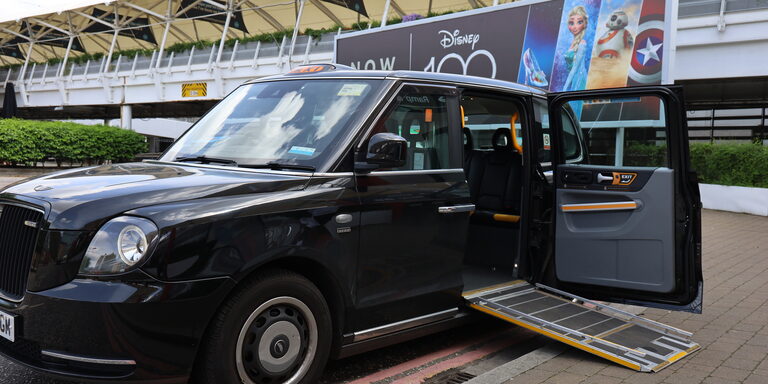
A London black cab with its wheelchair ramp down. Every black cab carries one.
There’s a black cab rank outside the terminal. Cabs are metered, and every black cab has a wheelchair ramp. A trip to central London costs about £47 to £65 and takes 35 to 55 minutes.
If a black cab driver doesn’t provide the right child seat, the law lets children travel without one, but only in a back seat, with an adult seat belt if they’re 3 or older and without a belt if they’re under 3.
Paying for a black cab
Paying at the airport
- Black cabs at the rank outside the terminal run on the meter, and every one must take contactless cards, with no extra charge for paying by credit or debit card.
- Black cabs also take cash. Tipping is up to you, but 10% is standard.
Booking ahead online or in an app
- You don’t need to book a black cab, because only black cabs can be hired at a rank without a booking.
Things to avoid
- Don’t get into a minicab you haven’t booked, including one whose driver comes up to you, because unbooked minicabs are illegal and uninsured for passengers.
Ride sharing
Uber and Bolt both work here, and the app shows where to meet your driver. Ride-share cars and pre-booked minicabs collect from the pick-up area in the Short Stay car park, close to the terminal. Drivers pay the airport £10 for up to 20 minutes there, so check the price in the app before you book.
The Freenow app, owned by Lyft, works here too and books both black cabs and minicabs, which it calls Ride. A Ride car takes up to four people at a fixed price shown before you book, and a black cab runs on the meter after showing an estimate, though for some trips from the airport the app shows a fixed fare instead. Freenow’s EV and XL black cabs have room for six people. Prices in the app include a £10 airport pick-up fee, and black cab trips carry a £2 service fee.
Uber, Bolt and Freenow don’t supply child seats; Freenow’s cars have Isofix fittings for your own seat and its drivers can refuse to take a child without one. If the driver of a licensed taxi or minicab doesn’t provide the right child seat, the law lets children travel without one, but only in a back seat, with an adult seat belt if they’re 3 or older and without a belt if they’re under 3.
Booking and paying for a ride share
Paying at the airport
- Uber and Bolt show the price in the app before you book a car, and so does Freenow for its Ride cars, but black cabs booked through any of the three run on the meter (Uber adds a £2 booking fee), unless Freenow offers a fixed fare for your trip.
Booking ahead online or in an app
- Uber lets you reserve a London City pick-up up to 90 days ahead and cancel free up to 60 minutes before the pick-up time.
Things to avoid
- Don’t get into a minicab you haven’t booked, including one whose driver comes up to you, because unbooked minicabs are illegal and uninsured for passengers.
- If the driver or the car’s number plate doesn’t match your booking confirmation, don’t get in, because it isn’t safe.
Once you’re in town, see Travelling around London for tips on getting about.
🛜 Free, unlimited WiFi throughout the terminal, with a filter that blocks unsuitable websites. Pick the free network whose name starts with ‘LCY’, then enter your email address and choose business or leisure as your reason for travelling.