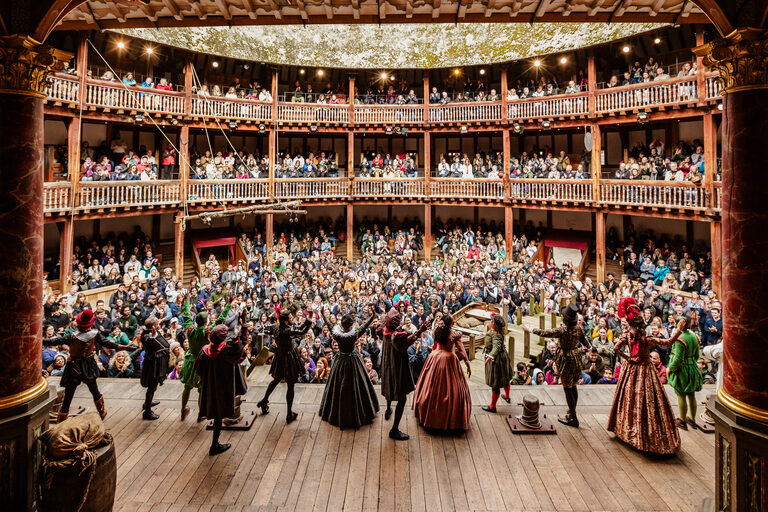
The cast of The Comedy of Errors on the Globe’s stage, facing a full house in the Yard and the galleries.
Before you go
- Prices
- Globe Theatre Guided Tour adults £31, under-16s £14; plays from £5 for a standing ticket in the Yard; see what’s on
- Open
- Guided tours daily at booked times, the last at about 5pm; exhibition 9am to 5.30pm (last entry 5pm), only with a tour or workshop ticket, or £5 extra with a matinee ticket; performance times vary, so see what’s on
- Nearest station
- Blackfriars (Circle and District lines, Southeastern and Thameslink), 10 minutes’ walk from the south exit, step-free; London Bridge (Jubilee and Northern lines, Southeastern, Southern and Thameslink), 15 minutes’ walk, step-free
- Plan your journey
- TfL Journey Planner, Google Maps or Uber
- Checked 31 October 2026
- Latest details on shakespearesglobe.com
Audience reactions to Pinocchio the Musical, from Shakespeare’s Globe’s YouTube channel.
For families
- Shakespeare’s Globe Website
- Visiting as a Family
- Family Events
- Guided tours: book ahead; the Globe Theatre Guided Tour starts at the Bankside Tours Entrance, not the main foyer.
- Pinocchio: the family musical, for ages 5 and up, in the open-air Globe Theatre; under-16s must sit with an adult (28 November 2026 — 3 January 2027).
- Open air: the Globe Theatre has no roof, and its standing places are not under cover; shows and tours go ahead in any weather, and umbrellas aren’t allowed. Bring a raincoat or buy a poncho from the theatre.
- Buggies (strollers): not allowed into shows or most of the tour, and buggy storage is small and unattended.
- Food and drink: your own food and drink are allowed in the theatres, but nothing in glass or porcelain.
- Bags: no bags bigger than 40cm x 35cm x 19cm, except for baby or medical equipment, and no luggage storage.
For neurodivergent visitors
- Relaxed performances
- Pinocchio visual story (PDF)
- Quiet space: in the Upper Foyer, with sensory aids and soft furnishings; ask staff to unlock if needed.
- Ear defenders: borrow a pair from the Welcome Desk.
Accessibility
- Access at Shakespeare’s Globe
- Access Scheme: free to join for Deaf, disabled and neurodivergent people, with up to two half-price tickets for most shows.
- Step-free entrance: the main foyer, at 21 New Globe Walk, has step-free access and lifts to every floor.
- Wheelchair users: both theatres and the guided tours are wheelchair accessible, but the tours’ usual route has stairs, so say when you book.
- Blue Badge (the UK’s disabled parking permit): ring the Box Office to book a free parking space.
- Captioned, signed and audio-described performances
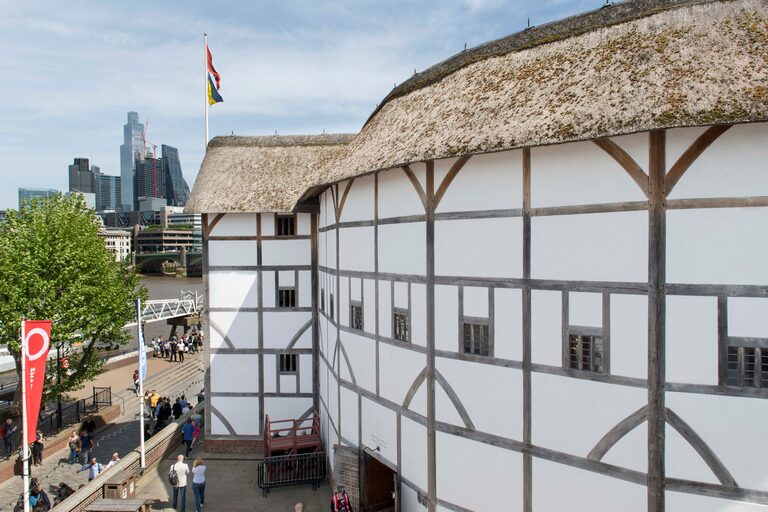
The Globe’s thatched roof and timber-framed walls beside the Thames, with the towers of the City of London across the river.
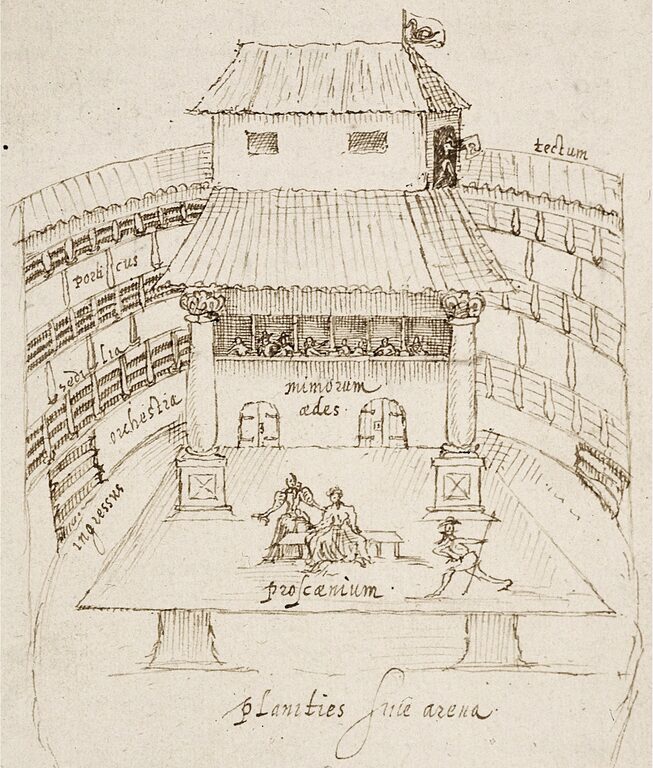
The Swan, a theatre near the Globe, sketched in about 1596.
Shakespeare’s Globe is really cool, and it’s well worth seeing a show here while you’re here in London. Real Shakespeare if your kids are old enough, or one of the kids’ shows if they’re not. It’s good value for money too, the cheapest tickets are only £5. Might be more memorable for the kids than another West End show!
So what is it? It’s a reconstruction of the Globe Theatre of 1599, the open-air wooden theatre owned by Shakespeare’s acting company. It stands on Bankside, just one street nearer the river than the original, next to Tate Modern and across the Thames from St Paul’s Cathedral. Beside it is a second, smaller theatre, the indoor Sam Wanamaker Playhouse, lit by more than a hundred beeswax candles.
The first Globe burned down in 1613, when a stage cannon set its thatched roof on fire. The actor Sam Wanamaker campaigned to rebuild it, and it opened in 1997. Its thatched roof needed special permission, because thatched buildings have been against the law in London since the Great Fire of 1666.
The guided tour and the exhibition
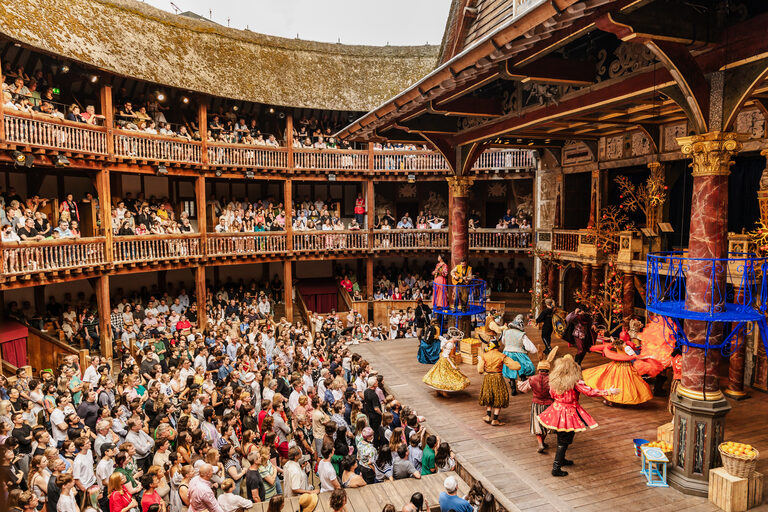
A full house for Much Ado About Nothing, seen from a gallery. People stand in the Yard and sit in three tiers of galleries round it.
The Globe Theatre Guided Tour, for all ages, takes about an hour and a half: 50 minutes with a guide inside the Globe Theatre, and time on your own in the exhibition. The guide tells the story of the first Globe, and how thousands of Londoners packed in to see its actors. Tours are in English, with information sheets in other languages. Some guided tours are family tours, aimed at children of 7 and over. The Globe is a working theatre, so when the stage is in use, the tour and photos may be restricted.
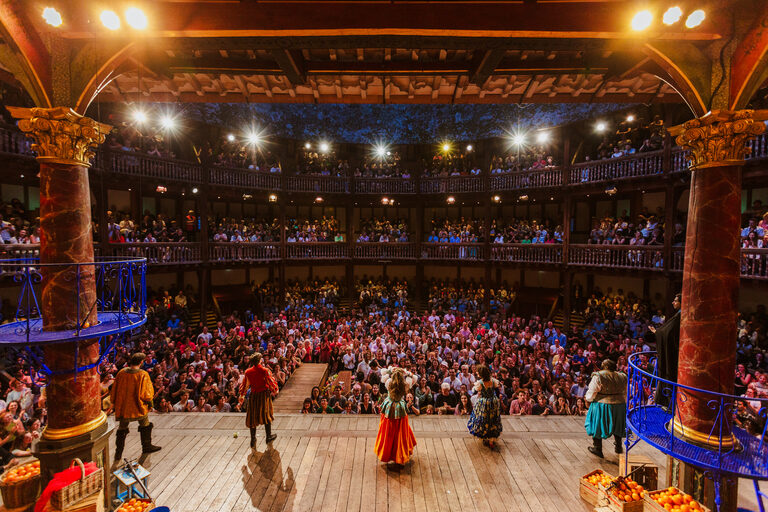
The view from the stage during Much Ado About Nothing, with the Yard and the galleries full.
The exhibition is the hands-on part, and the part to save time for with younger children. They can try on costumes and props used by Globe actors, then pick up a script and perform on a copy of the Globe stage. There are discovery boxes and games, smells from Shakespeare’s time, and a giant xylophone to play. You can see the old printing press in use and find out how special effects such as rolling thunder work.
Allow about 30 minutes for the exhibition. If your tour starts at 5pm or later, go round the exhibition before it. With a ticket for a matinee (daytime) performance in either theatre, entry to the exhibition costs £5 extra.
Family workshops and storytelling
Drama workshops are for children of 5 to 8 or 9 to 11 with their grown-ups. Family Storytelling performances tell a Shakespeare play for children of 5 to 11 and their families.
Seeing a play
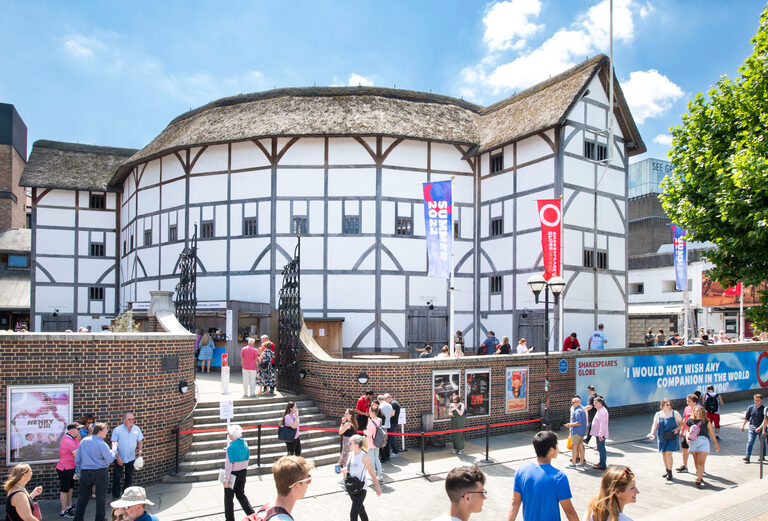
The Globe from the street, with posters for its plays on the wall in front.
In the Globe Theatre, the cheapest way to see a play is to stand in the Yard, the open ground in front of the stage. Standing (Groundling) tickets cost £5 or £10 with no booking fee, and either price lets you stand anywhere in the Yard. The £5 tickets can sell out. In the summer season, every Friday at 11am, a limited number of £5 tickets for the following week’s plays go on sale online (the £5 Rush).
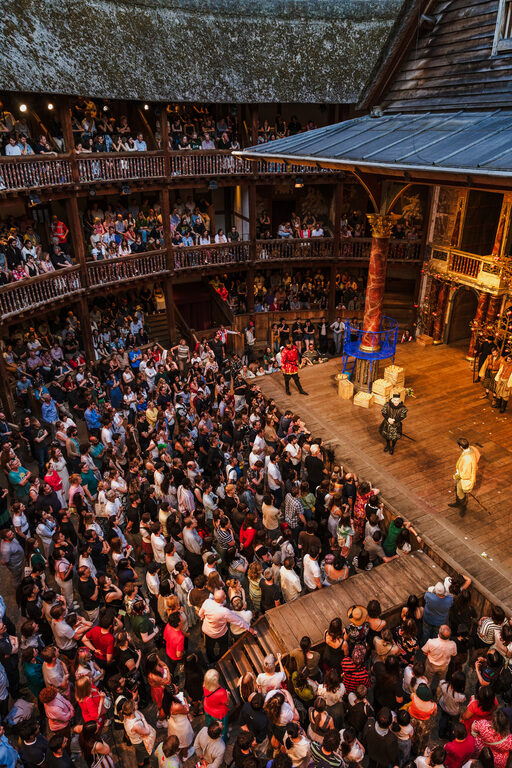
Looking down on the Yard, packed with people standing to watch Much Ado About Nothing.
You stand for the whole play, which can last 2 hours 45 minutes, including a 20-minute interval (break). Nearly three hours on your feet is a lot for a young child, but in the Globe Theatre you can go out and come back in at any time. With young children we’d choose the tour and exhibition or a family show, and leave a full play until they’re older.
The Globe Theatre’s seats are benches in three galleries round the Yard. Most of them are under cover, but you can still get wet or sit in direct sun. You can hire cushions, blankets and seat backs, and buy rain ponchos. With a baby, a seat on the ground floor by an aisle makes it easy to slip out.
The next door Sam Wanamaker Playhouse is indoors and air-conditioned with cushioned benches. If a baby gets restless, you can step outside and watch the play on a screen. A child under 4ft can’t see the stage from the Playhouse’s standing places, and young children may find it hard to see from its Upper Galleries, so book seats on a lower level.
Food, babies and buggies
The Foyer Café sells sandwiches and snacks to eat in or take away, and it’s open in every show’s interval. The Swan bar and restaurant has a children’s menu, highchairs and views across the river to St Paul’s.
You can breastfeed anywhere, and staff will warm a bottle, give you hot water for formula, or warm your own baby food, free. There’s baby changing in the gender-neutral toilet next to the Shop (take the lift from the main foyer to Piazza Level).
Come without a buggy (stroller) if you can, and use a sling or baby carrier.
Getting there
River buses (Uber Boat by Thames Clippers) stop every 20 minutes, all day and until late at night, at Bankside Pier, 10 metres from the Globe. The Millennium Bridge, a footbridge across the Thames, is 50 metres from the Globe.